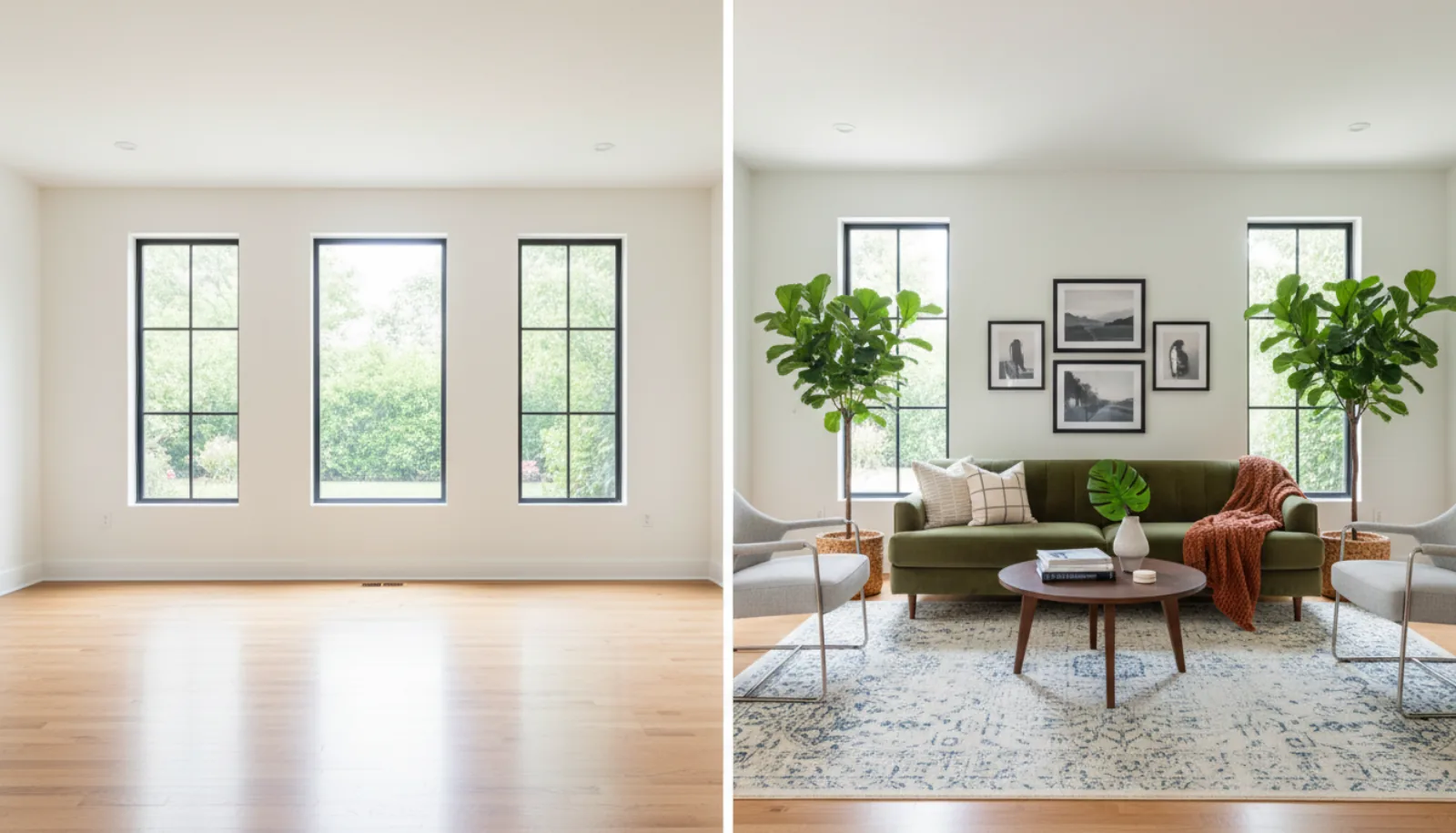
If you’re going to stage only one room in a house, make it the living room. Hands down, it’s the single most important space for winning over potential buyers and securing a top-dollar offer.
This isn’t just about making the room look nice. It’s a strategic marketing move designed to forge an instant emotional connection. When buyers can picture themselves relaxing on the sofa or hosting friends, they’re no longer just looking at a house; they’re envisioning a home.
Why the Living Room Is the Key to a Successful Sale

Think of your living room as the property’s first impression. It’s often the first real space a buyer experiences after walking through the front door, and it sets the tone for the entire showing. A cluttered, poorly lit, or awkwardly arranged room can immediately sour their opinion.
But a well-staged living room? That’s a different story. It creates an aspirational feeling that carries through the rest of the tour.
The goal is to move beyond your own personal taste and create a welcoming, beautiful space that appeals to the widest possible audience. When a buyer walks in, they need to see three things immediately:
- Function: The layout should be intuitive, clearly showing how the room works for everyday life, from family movie nights to entertaining guests.
- Space: Furniture should be arranged to make the room feel as large and open as possible. It’s all about showcasing the square footage, not filling it up.
- Possibility: Most importantly, it has to feel like a blank canvas, allowing buyers to mentally “move in” their own furniture and start imagining their life there.
The Numbers Don’t Lie
My experience in the field is backed up by hard data. The living room is, without a doubt, the most critical area for staging. An overwhelming 91% of staged homes include a focus on this space.
Why? Because it’s what buyers care about most. Research from the National Association of Realtors shows that 46% of buyer agents say the living room is the most important room to stage. That puts it ahead of the primary bedroom (43%) and even the kitchen (35%).
Let’s look at what this means for your sale in a more concrete way.
Living Room Staging Impact at a Glance
The statistics clearly show that focusing your efforts on the living room isn’t just an expense—it’s an investment with a measurable return.
| Metric | Impact of Staging |
|---|---|
| Buyer’s Perception | 46% of buyer agents cite the living room as most critical. |
| Likelihood to Stage | 91% of all professionally staged homes include the living room. |
| Sale Price | Homes with staged living rooms can sell for 1-5% more. |
| Time on Market | Staged homes sell 88% faster than non-staged ones. |
When you create a living room that buyers fall in love with, you’re not just selling a room; you’re selling a lifestyle. This emotional connection often translates directly into faster sales and higher offers.
The psychology here is pretty straightforward. If a buyer loves the living room, they are far more willing to overlook small issues elsewhere in the house. That initial “wow” factor creates a powerful halo effect.
In today’s market, where most buyers start their search online, your living room’s photos are your primary marketing tool. A poorly presented space gets scrolled past in seconds, but a stunningly staged one earns clicks, saves, and, ultimately, showing requests.
The investment in staging the living room more than pays for itself. To see how these principles apply to the entire property, check out our complete guide on how to stage a home.
Prep the Space: Your Foundation for a Successful Staging

Before you even think about furniture placement or decor, you have to prep your canvas. The single biggest mistake I see homeowners make is trying to style a room that hasn’t been properly cleared out. You’re not just tidying up; you’re creating a neutral, inviting space where buyers can project their own lives and dreams.
This all starts with a deep, top-to-bottom clean. I’m not talking about a quick weekend spruce-up. We need to get into the details that buyers absolutely notice, even if only subconsciously. Think baseboards, ceiling fan blades, window sills, and light fixtures. A sparkling clean room signals a well-maintained home, which is a huge selling point.
Make it a Blank Slate
Next, it’s time to take the “you” out of the house. This can be the hardest part emotionally, but it’s critical for a quick sale. When a potential buyer walks in and sees your family vacation photos or your kid’s artwork on the fridge, it immediately reminds them they’re a guest in a stranger’s home. You want them to feel like they could move in tomorrow.
Here’s what needs to be packed away:
- Personal Photos: All of them. Replace them with some neutral, appealing art or simply leave the wall space clean and open.
- Collections & Trophies: Your prized sports memorabilia or unique collections are part of your story, but they can be a major distraction. Box them up.
- Everyday Clutter: Piles of mail, magazines, TV remotes, and charging cables all scream “daily chaos.” The goal here is a serene, almost hotel-like atmosphere.
The moment a buyer connects a personal item to you, the seller, they stop picturing the house as theirs. By removing those identifiers, you’re handing them the keys, psychologically, to imagine their own future in the space.
The Decluttering Mindset
Once the personal items are gone, it’s time to tackle everything else. Overstuffed bookshelves and too much furniture can make even a large living room feel cramped and small. Your job is to edit ruthlessly to maximize the feeling of space and flow.
I always tell my clients to use a three-bin system for every item that isn’t essential furniture: Store, Donate, or Discard. If it isn’t directly contributing to showcasing the room’s best features, it needs to go. For a more detailed, room-by-room plan, our guide on how to declutter a home for sale is a great resource.
Only after you’ve stripped the room down to its best version can you start adding things back in. This selective process allows you to place items with intention. For instance, once the room feels open, you might find that adding a few elegant touches, like chic gold coffee tables, can elevate the entire feel and create a sophisticated focal point. This isn’t just cleaning—it’s strategic editing that sets you up for the next phase: arranging the furniture.
Arranging Furniture to Showcase Flow and Function

Your furniture layout is the first thing that tells a buyer how they could actually live in the room. I’ve walked into countless homes where sellers make the same classic mistake: every single piece of furniture is shoved up against the walls. It’s an understandable impulse—it seems like it would make the room look bigger.
But it does the exact opposite. All that empty space in the middle creates a cold, awkward “dance hall” effect that makes the room feel smaller and less usable.
The secret from professional stagers? Create conversational zones. When you pull your furniture away from the walls and group it together, you instantly build a sense of intimacy and function. This “floating” arrangement makes a room feel larger, more thoughtfully designed, and way more inviting. It subtly communicates to buyers, “This is a place to connect and relax.”
Mastering how to arrange living room furniture is a game-changer for getting top dollar. A good rule of thumb is to always start with your largest piece, which is usually the sofa, and build the entire room out from there.
Create a Clear Focal Point
Every well-staged living room has a clear focal point. It’s the spot where your eyes naturally go when you first enter. All your furniture should be arranged to celebrate this feature, not fight it for attention.
What makes a good focal point? Look for these first:
- A Fireplace: This is a classic. Position your main seating to face the fireplace. A sofa placed directly opposite, with a pair of armchairs flanking the hearth, creates a timeless, symmetrical look that feels both grand and cozy.
- A Large Window with a View: Don’t you dare block a gorgeous view with a bulky sofa back! Instead, try arranging your seating perpendicular to the window. This allows someone to enjoy the scenery while still being part of the conversation in the room.
- A Built-in Bookshelf: Frame those built-ins to create a dedicated reading area. All it takes is a comfortable armchair, a small side table, and a good lamp to turn an architectural detail into a lifestyle feature.
If your living room doesn’t have a standout architectural feature, don’t worry. You can create one. A large, compelling piece of art or a stylish media console can easily anchor the room and give it that much-needed sense of direction.
Defining Zones and Pathways
In a modern, open-concept home, using furniture to define distinct “zones” is absolutely critical. This is where area rugs become your best friend. A well-placed rug anchors your main seating group and visually separates the living area from a nearby dining space or entryway. It’s a clear signal that says, “This is the living room.”
Just as important is leaving clear, obvious pathways for people to move through the space without weaving around furniture.
A major walkway needs to be at least 36 inches wide to feel open and comfortable. For the tighter spaces, like between a coffee table and a sofa, you can get away with 18 inches, but no less. This is what makes a room feel easy to navigate instead of cramped.
Here’s a pro tip: place a console table behind a floating sofa. This simple trick creates a soft boundary and an implied hallway, directing foot traffic around your seating area, not straight through it. It’s a small detail that adds a huge amount of sophistication.
Look for those awkward, empty corners, too. With an armchair, a floor lamp, and a tiny table, that dead space is now an intentional reading nook. This demonstrates to buyers that every last square foot of the home is usable, and that’s how you show value.
Using Light and Color to Make Your Space Shine
Light and color are your secret weapons in home staging. They’re what turns a nice room into an unforgettable one, creating that “wow” moment that sticks with a buyer long after they’ve left. Getting this right is about making the living room feel bright, airy, and full of potential.
Most homes rely on a single, lonely overhead light. We’re going to do better. The professional approach is all about layered lighting, a technique that uses three distinct types of light to build depth and warmth. It’s what makes a staged room feel so intentional and polished.
- Ambient Light: This is your foundation—the general light from recessed cans or a central fixture that fills the space.
- Task Light: Think practical. This is the focused light for specific activities, like a sleek floor lamp placed next to an armchair for a cozy reading spot.
- Accent Light: This is the fun part. You use accent lights to spotlight the good stuff, drawing a buyer’s eye to beautiful artwork, a fireplace mantel, or cool architectural details.
When you blend all three, you wash away any dark, uninviting corners. The result is a warm, cohesive glow that looks fantastic in photos and feels even better in person.
Let There Be (the Right) Light
The first thing I do in any living room is figure out how to maximize natural light. It’s the best asset you’ve got. Ditch any heavy, dark, or dated draperies—they’re probably blocking light and screaming “old-fashioned.”
Replace them with simple, sheer white curtains. Here’s a pro tip: hang the curtain rod high above the window frame and extend it wider than the window itself. This trick makes the windows seem much larger and allows sunlight to flood the room.
Next, take a look at your light bulbs. If you’ve got bulbs casting a harsh, cool, almost blueish light, swap them out immediately. You’re looking for bulbs that produce a soft, warm glow, typically in the 2700K-3000K temperature range. This one small change can make a room feel instantly cozier. For a deeper dive, check out our tutorial on how to improve the lighting of any room.
Before you call it a day, flick every single light switch. Make sure every fixture works and that all bulbs match in color. A burnt-out bulb or mismatched lighting can give buyers the subtle impression that the home hasn’t been well-maintained.
Using Color to Sell
I’ve seen it a hundred times: a seller loves their bold accent wall, but for buyers, it’s a major turn-off. When you’re selling, your personal taste takes a backseat to mass appeal. The goal is to create a serene, neutral backdrop where buyers can easily picture their own lives unfolding.
A neutral wall color is non-negotiable. I stick with a palette of soft grays, warm off-whites, or sophisticated beiges. These shades are popular for a reason—they make rooms look bigger, brighter, and they appeal to almost everyone. They are the perfect blank canvas.
Of course, neutral doesn’t have to mean boring. Once you’ve got that calm foundation, you can bring in personality with smart, strategic pops of color. Think a couple of throw pillows in a rich navy, a soft sage green blanket draped over the sofa, or one vibrant piece of abstract art. This is how you create a memorable focal point without alienating anyone. It looks stylish and thoughtful, showcasing the room’s potential without screaming a specific style.
Gain a Competitive Edge with Virtual Staging
While there’s a time and place for traditional physical staging, it often brings significant costs, logistical challenges, and long turnaround times. For agents and sellers aiming for maximum impact with minimal fuss, virtual staging has become a game-changing alternative. It completely reimagines how a property is marketed, turning an empty or cluttered room into a captivating, photorealistic image that stops online buyers in their tracks.
Imagine you have a photo of a vacant living room. Within minutes, you could showcase it in multiple distinct styles. Using AI-powered tools like BrightShot, you can instantly apply a sleek ‘Scandinavian’ look, a cozy ‘Modern Farmhouse’ vibe, or even a high-end ‘Contemporary’ design. This gives you the power to tailor your listing photos to specific buyer tastes—a feat that’s simply not practical with physical furniture.
Slash Costs and Accelerate Timelines
The numbers really tell the story. Traditional staging can be up to 97% more expensive than virtual staging. Instead of waiting weeks for furniture delivery and setup, you can have stunning, scroll-stopping images ready in seconds.
This approach isn’t just about pretty pictures; it’s about accelerating the entire sales process. We’ve seen that professionally staged homes sell an average of 73% faster, dramatically cutting down the days on market from a typical 90 to just 24. The return on investment is just as compelling, with virtual staging delivering returns anywhere from 500% to over 3,600%. For a closer look at the financial side, you can explore the latest virtual staging market trends.
This flowchart helps visualize how to quickly handle common lighting issues you might encounter when prepping a room for photos.

As you can see, fixing the lighting doesn’t have to be a complicated affair. A few key decisions can make all the difference.
Physical vs Virtual Staging Comparison
To put it all in perspective, here’s a direct comparison between the two methods. The differences in cost, time, and flexibility are stark.
| Factor | Physical Staging | Virtual Staging (with BrightShot) |
|---|---|---|
| Cost | $2,000 - $7,000+ per project | $25 - $100 per image |
| Timeline | 1-3 weeks for consultation, delivery, setup | 5-10 minutes per image |
| Flexibility | Locked into one style once set up | Instantly change styles and layouts |
| Logistics | Requires movers, furniture rental, insurance | Just upload a photo |
The table makes it clear: virtual staging offers a faster, more affordable, and incredibly adaptable solution for modern real estate marketing.
How AI Virtual Staging Works
The process itself is surprisingly simple. It all starts with uploading a photo of the room you want to stage. This can be a completely empty space or even a room still filled with the seller’s furniture.
From there, platforms like BrightShot use AI to analyze the room’s dimensions, lighting, and perspective. This gives you two powerful options:
- Virtual Staging: If the room is vacant, you can choose from a library of professionally designed styles to instantly furnish the space.
- Virtual Decluttering: If the room is occupied, the AI can digitally erase the existing furniture and clutter, giving you a clean slate to stage virtually.
This creates the perfect “before-and-after” scenario for your marketing, showing buyers the home’s true potential without the headache of physically moving a single item.
The core benefit of virtual staging is its flexibility. You’re no longer locked into one look. You can create multiple versions of the same living room to see what resonates most with your target buyer demographic, all for less than the cost of a single rental chair.
This technology empowers you to present every property in its best possible light, ensuring your online listing captures attention and drives more qualified buyers to schedule showings. To fully understand the software powering this shift, check out our deep dive into the best real estate virtual staging software. The right tool truly makes all the difference.
Common Questions About Staging a Living Room
No matter how many times you’ve staged a home, a few practical questions always seem to pop up. It’s completely normal. Let’s walk through some of the most common hurdles sellers and agents run into and get you some clear, straightforward answers.
How Much Does It Really Cost to Stage a Living Room?
This is the big one, and the answer really depends on which path you take. Traditional, physical staging is a serious financial commitment. You’re typically looking at a bill between $1,500 and $3,000, sometimes even more, for a one-month rental. That price usually covers the design consultation, all the furniture and decor, plus delivery and setup, but it’s a significant upfront cost.
On the other hand, virtual staging completely changes the math. With a good AI platform, you can digitally furnish photos of your living room for just a few dollars an image. It’s an incredible marketing tool because it lets you showcase the room’s potential in different styles without the logistical headache or the hefty price tag.
The real question isn’t just about the initial cost, but the return on your investment. Virtual staging can be up to 97% cheaper than physical staging, yet it still creates that powerful emotional pull that gets buyers interested online.
Is It Better to Stage an Empty Room or One with Furniture?
An empty living room is a tough sell. I’ve seen it countless times—buyers walk into a vacant space and can’t figure out if their sofa will fit. They often assume the room is smaller and colder than it really is. If you’re starting with a blank slate, staging isn’t optional; it’s essential to give the room context and warmth.
Now, if you already have furniture, the game is all about editing. You have to be ruthless. Only keep pieces that are neutral, in great shape, and scaled correctly for the space. Everything else? It has to go into storage.
For vacant homes, virtual staging is hands-down the most powerful strategy. It fills that empty void in the online photos, which is where 95% of buyers start their search. You can instantly add beautiful, aspirational furniture that helps a buyer fall in love with the home before they even book a showing.
Can I Use Virtual Staging for an Occupied Home?
Absolutely. In fact, this is one of the biggest advantages for sellers who are still living in the property. It’s a huge time and back-saver.
Modern AI staging tools often come with a feature called “virtual decluttering” or item removal. You can take a picture of your living room as-is—clutter and all—and the AI digitally removes your existing furniture. From that clean slate, you can virtually stage the room with a completely new, on-trend design. This is a game-changer for occupied homes because you get perfect listing photos without the chaos of moving furniture or renting a storage unit.
What Are the Most Important Steps on a Tight Budget?
If your funds are limited, you have to be strategic. Focus your time and money where you’ll get the most bang for your buck. These three actions deliver the biggest impact for the lowest cost:
- Declutter and Deep Clean: A sparkling clean, open space automatically feels more valuable. This costs you nothing but elbow grease, so be relentless.
- Maximize All Light: Get rid of heavy, dark drapes. Wash every window, inside and out. Swap any dim or cool-toned lightbulbs for brighter, warmer ones to create an inviting glow.
- Perfect Your Layout: This is a classic staging trick that costs nothing. Just pull your furniture away from the walls and arrange it into a cozy, central conversation area. A few small tweaks to improve the flow can make a room feel professionally designed.
Ready to create stunning, scroll-stopping listing photos in seconds? BrightShot uses AI to instantly handle virtual staging, decluttering, and photo enhancement with one click. Try BrightShot for free and transform your property images today.