Social media marketing for real estate agents has changed more in the last 18 months than in the previous decade. Buyers under 40 now find roughly half their listing leads on Instagram, TikTok and Facebook before they ever open Zillow — and the agents who consistently show up in those feeds are running on a 2026 playbook that looks almost nothing like the 2022 “post a Just Listed graphic to Facebook” routine.
This guide is the version we wish we’d had when we started. It covers what actually works in real estate social media marketing today: the platform mix, the content types that convert in 2026, how often to post without burning out, what hashtag and caption strategy still moves the needle, and the AI tools that have collapsed the 30-minute “design + caption + post” cycle into roughly 60 seconds.
If you’re an active agent or a small team without a dedicated marketing hire, this is written for you. Social is one of five channels — for the wider stack (listings, email, geo, paid) and how social fits in, see our complete real estate marketing playbook for agents.
⚡ Skip the design + caption + scheduler stack — BrightShot bundles AI captions, property overlays, brand watermarks, and one-click publishing to Instagram, TikTok, and Facebook in one $19/mo plan. Try the free plan →
What is real estate social media marketing in 2026?
Real estate social media marketing is the discipline of using Instagram, TikTok, Facebook, and YouTube to generate listing leads, build a personal brand, and shorten time-on-market for active inventory. The mechanic is simple: buyers and sellers spend 2-3 hours per day in social feeds, and the agents whose content shows up in those feeds get the listing call when it’s time to buy or sell.
What’s different in 2026 vs. earlier years:
- Video is no longer optional. Reels and TikTok now drive the majority of new-buyer leads for active social agents — static carousel posts still convert but no longer “discover” new audience. For the full distribution playbook by video type, see our real estate video marketing guide.
- Branding consistency now matters more than post volume. Three professionally-branded posts a week beats fifteen ad-hoc posts a month.
- Multi-platform is the baseline. The same listing shows up on Instagram (visual buyers), TikTok (younger demo + national virality), and Facebook (45+ buyers, group communities). Single-platform agents have a clear ceiling.
- AI has eaten the design and copy bottleneck. What used to take Canva + a copywriter + a scheduler can now run end-to-end in under a minute.
The agents winning this game aren’t the ones with the biggest content teams. They’re the ones whose workflow lets them ship one professionally-branded multi-platform post per active listing without it eating their week.
Why social media marketing matters for real estate agents
The numbers from the most recent NAR Real Estate in a Digital Age report tell the story:
- 77% of real estate agents actively use social media for their business
- Realtors who post 3-5 times per week generate roughly 2× the leads of those who post less than once per week
- Listings with property video receive 403% more inquiries than photo-only listings
- Listings with virtual tours generate 87% more views and sell up to 31% faster
The buyer side is even sharper:
- 97% of home buyers start their search online — and increasingly that “online” means a social feed before it means a portal
- Buyers under 40 now check an agent’s Instagram or TikTok presence before scheduling the first call — agents with thin or inconsistent profiles lose those buyers to better-marketed competitors
- Sellers say the agent’s marketing strategy is one of the top three factors in choosing a listing agent — and “marketing strategy” in 2026 increasingly translates to “social media presence and reach”
The cost of NOT doing social media marketing for real estate is no longer “we’ll get fewer leads.” It’s “the seller picks the other agent because their Instagram looks more professional.”
The platform strategy that actually works
Most real estate social media advice tells agents to “be everywhere.” That’s bad advice. Be everywhere your buyers are, in the format each platform actually rewards. Here’s what that looks like in practice.
Instagram — the primary engine
Instagram is still the highest-ROI platform for real estate agents in 2026, mostly because the algorithm rewards visual content (which agents have abundant) and the audience skews toward the 28-55 buyer demographic. Three formats matter:
- Reels (9:16 vertical video, 15-60 seconds) — primary discovery vehicle. A walkthrough of a listing, a before/after staging reveal, or a market-update voiceover all work. Algorithm pushes Reels to non-followers, which is how you grow.
- Carousel posts (4:5 vertical, up to 10 images) — best for listings. Drag-to-see swipes generate 2-3× more engagement than single-image posts. Lead with the most striking exterior shot, then walk the buyer through 6-10 interior shots.
- Stories (9:16, 24-hour) — best for behind-the-scenes, polls, and quick price-reduction or open-house announcements. Lower production effort, higher frequency.
For Instagram, a sustainable cadence is: 2-3 carousel posts per week (one per active listing minimum), 2-4 Reels per week (mix of property video, market updates, agent personality), and daily Stories (low-effort, high-presence).
TikTok — discovery + younger buyers
TikTok is where the next 5 years of buyers are forming opinions about who their agent will be. The platform skews younger (24-40), but those people are buying their first or second home in the next 24 months. Three TikTok content patterns work for real estate:
- Property walkthroughs (60-90 seconds, vertical) — the buyer’s POV walking the listing, voiceover narrating selling points
- Market explainers (30-60s) — “what $500K buys in [city]” comparisons, mortgage rate context, off-market trends
- Behind-the-scenes (60s) — open house prep, staging reveal, signing day, the funny things that happen in showings
TikTok rewards posting frequency more than Instagram does. Three to five posts per week is the sustainable target. Most TikTok-native agents repurpose Instagram Reels here directly — same vertical aspect ratio, light edit to remove Instagram-specific overlays.
Facebook — older demo + community groups
Facebook reach has declined for organic posts, but the platform still matters for two specific things:
- Local Facebook groups — most cities have 5-50 active “Buy/Sell/Trade” or neighborhood groups. Agents who participate genuinely (answer questions, share market data, occasionally post listings) get DM-based seller leads consistently.
- The 45-65 buyer demographic — older move-up buyers and downsizers still primarily browse Facebook. Listings posted to a personal page + business page + relevant groups reach them.
Facebook is the lowest content-creation overhead of the three: most agents simply re-post their Instagram carousels here. The lift is logging in and engaging in groups, not creating new content.
YouTube — long-form (optional)
YouTube is a long-term investment that pays dividends if you stick with it. Long-form property tours (5-15 min), neighborhood guides, and “what’s it like to live in [city]” content rank in Google and YouTube Search for years after publishing. Most agents underinvest here because the production effort feels heavier — but a single well-ranked YouTube video can drive leads for 3+ years vs. a TikTok that has a 7-day half-life.
If you’re starting fresh, prioritize Instagram → TikTok → Facebook → YouTube in that order. Don’t try to launch all four simultaneously.
Jimmy Burgess’s distillation of the five Instagram growth signals that actually compound for working agents — saves, shares, profile visits, watch-through, and DM sends — is one of the more concrete platform-strategy videos out there:
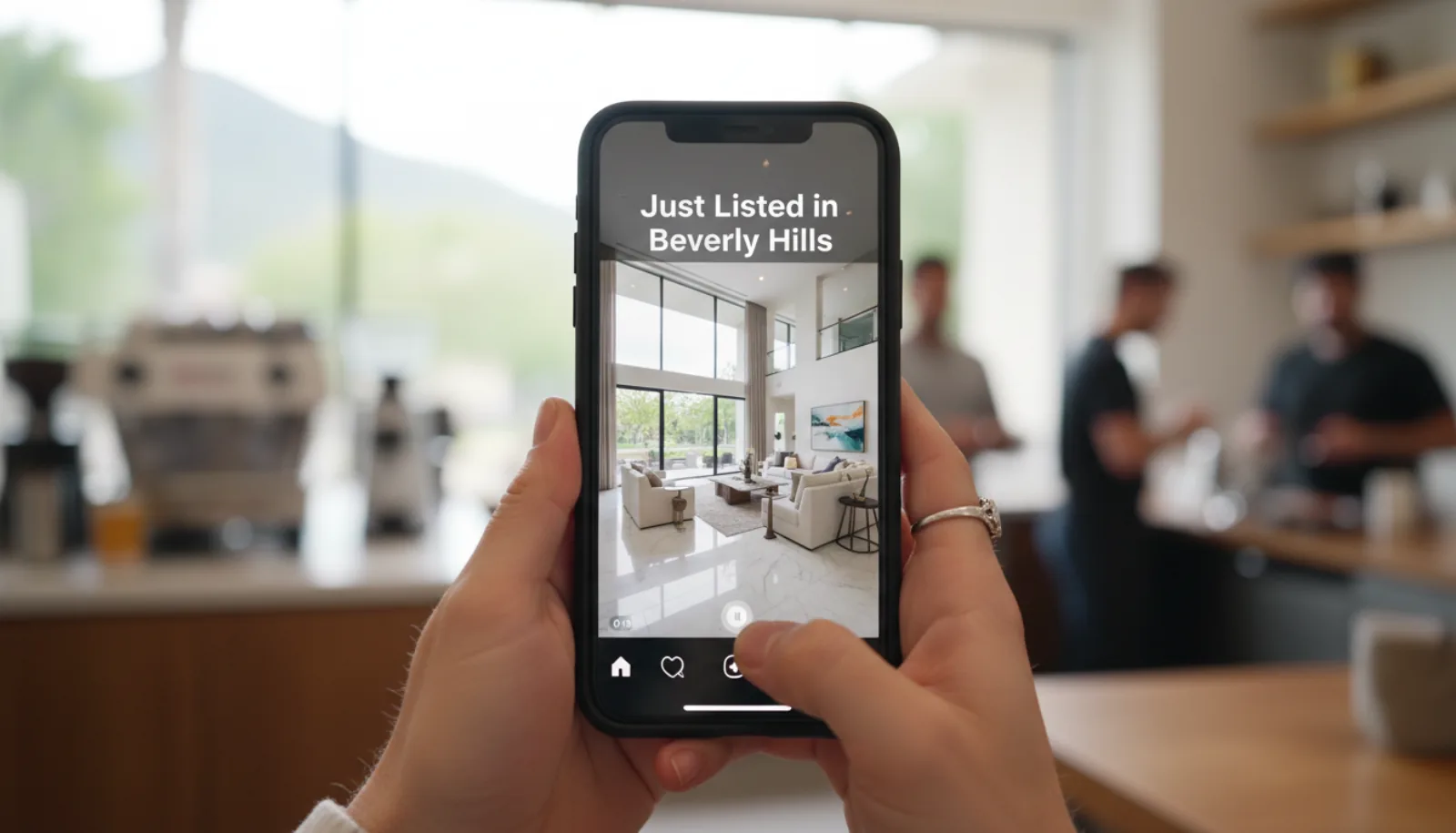
The Reels feed is where most discovery happens — vertical, fast, and unforgiving on the first 1.5 seconds:
What to post: content types that actually convert
Most “real estate social media post ideas” articles list 100 things and don’t tell you which ones work. Here’s the honest ranking, based on what consistently moves engagement and leads in 2026:
Tier 1 — drives leads directly:
- Just-listed posts (carousel + Reel) — every active listing should ship at least one of each
- Just-sold posts with closing testimonial — social proof that compounds
- Open-house announcements with the property’s best 3-4 interior shots
- Price-reduction announcements (carousel showing the new price prominently)
- Buyer/seller testimonials (video > text)
Tier 2 — builds brand and SEO trust:
- Neighborhood spotlights (“5 things you’ll love about [neighborhood]”)
- Market updates monthly (“here’s what happened to [city] prices in [month]”)
- Day-in-the-life behind-the-scenes (humanizes you, makes you the obvious choice for first-time buyers)
- Educational content (“what is earnest money,” “how appraisal contingencies work”)
- Before-and-after staging or renovation reveals — these consistently outperform almost everything else (see our staging before-and-after gallery for examples to recreate)
Tier 3 — fills the calendar but converts less:
- Holiday posts, agent-life-quotes, motivational content, trending audio jumps without real estate angle
Cap Tier 3 at 10% of your output. Spend the rest on Tier 1 and Tier 2.
If you want a longer breakdown, see our 29 real estate social media post ideas post for templates and examples.
How often should real estate agents post?
The honest answer is: consistency beats frequency, but frequency matters more than most agents think.
The realistic sustainable target most successful agents hit:
- Instagram: 3-5 posts per week (mix of Reels and carousels) + daily Stories
- TikTok: 3-5 posts per week
- Facebook: 2-3 posts per week + active group participation
- YouTube: 1-2 long-form videos per month (optional)
That’s roughly 10-15 pieces of cross-posted content per week. The reason most agents fail this isn’t strategy — it’s the per-post time cost. Designing a carousel in Canva, writing a caption, finding hashtags, resizing for each platform, and publishing across three apps takes 30-45 minutes. Multiply by 10-15 posts a week and you’ve added 5-11 hours of design work per week to your schedule.
This is why most agents post inconsistently. Not because they don’t know they should — because the unit economics don’t work without automation.
Captions and hashtags — what still works in 2026
The caption rules have changed in the last two years:
- Lead with the hook. First line is what shows in the feed before “more.” If it’s “Just listed!” you’ve lost. If it’s “$485K in [neighborhood] — and the kitchen alone made me text my husband,” you’ve earned the click.
- Length matters less than rhythm. Short captions (30-50 words) work for Reels. Longer captions (150-300 words) outperform short ones on carousels because Instagram weighs “time on post.”
- One CTA per post. “DM me ‘TOUR’ for a private showing” beats three competing CTAs.
- Hashtags moved to the comment. Putting 15-25 relevant hashtags in the first comment (not the caption) keeps the caption clean and still gets indexed.
Hashtag strategy in 2026:
- 5 hyper-local hashtags (#[city]realestate #[neighborhood]homes #[city]realtor)
- 5 listing-specific (#justlisted #openhouse #newconstruction #[city]homes #firsttimebuyer)
- 5 broader real estate (#realestate #realtor #realestateagent #realestatelife #homesweethome)
- 5 platform-trending (rotate based on current Instagram/TikTok trends)
Generic hashtag strategy is dead. Geo-specific + property-specific outperforms broad real estate hashtags by 3-4× in reach for new accounts.
If you’re writing every caption and researching every hashtag manually, this is the second time-bottleneck after design. AI caption tools that pull from your listing data (price, location, beds, baths, key features) and auto-generate the caption + hashtags solve this in 5 seconds per post — see the tools section below.
The branding rules that actually matter
Three things make an agent’s social feed look professional vs. amateur:
- Consistent watermarking. Your logo + agent name + phone in the same corner of every image. Buyers scrolling a feed should recognize a post is yours within half a second.
- Property overlay graphics. Price, beds, baths, square footage rendered cleanly on the first image of every listing carousel. Most amateur agents skip this; professional agents include it on every post.
- Color palette consistency. Two brand colors (your primary + an accent) used on every overlay. Mix-and-match colors look like the work of three different freelancers.
This is the single biggest “looks expensive” factor on real estate social media. The good news: once you set the brand kit once, automated tools render every overlay in your colors automatically — no per-post design work.
Tools that make this sustainable
The 2026 social media stack for a real estate agent has consolidated dramatically:
Old stack (3-4 separate tools, $80-150/mo combined):
- Canva or Photoshop — for property overlays and carousel design
- A copywriter or ChatGPT — for captions and hashtags
- Buffer / Hootsuite / Later — for cross-platform scheduling
- A separate analytics tool — for tracking performance
2026 stack (one real-estate-specific tool):
- An AI tool that ingests listing data, applies your brand kit, generates captions, and publishes to Instagram + TikTok + Facebook in one click
This is what BrightShot’s social media automation does specifically: upload listing photos, the AI applies your brand watermarks + property overlays + generates real estate captions with the right hashtags + publishes to all three platforms simultaneously. The whole sequence runs in under 60 seconds per listing, replacing roughly 30-45 minutes of design + caption + scheduler work.
The decision tree if you’re picking a social tool:
- If you publish 1 listing a month: any free tool works — Canva + ChatGPT + native scheduling on each app
- If you publish 2-5 listings a month: a real-estate-specific automation tool pays for itself within the first listing in time saved
- If you publish 5+ listings a month: you cannot sustain consistency without automation; the tool choice is “which one”
Generic schedulers (Hootsuite, Buffer) work for posting but don’t generate the visual content or captions — you’re still on the hook for design and copy. Real-estate-specific tools (BrightShot, Pedra, Curated Social) handle the full pipeline. We compare them in our BrightShot vs Pedra breakdown.
The workflow that scales without a marketing hire
Here’s the actual production workflow most successful single-agent or small-team operations follow in 2026:
Once per quarter (~2 hours):
- Set or refresh the brand kit (logo, primary color, accent color, font, contact info)
- Define content pillars (e.g. 40% listings, 30% educational, 20% community/neighborhood, 10% personal)
Per listing (~15 minutes):
- Shoot or upload listing photos (already part of the listing prep workflow)
- Run them through AI staging / photo enhancement if needed (5 min)
- Generate the social posts: AI applies overlays, writes captions, queues for IG + TikTok + FB (5 min)
- Review captions and publish (5 min)
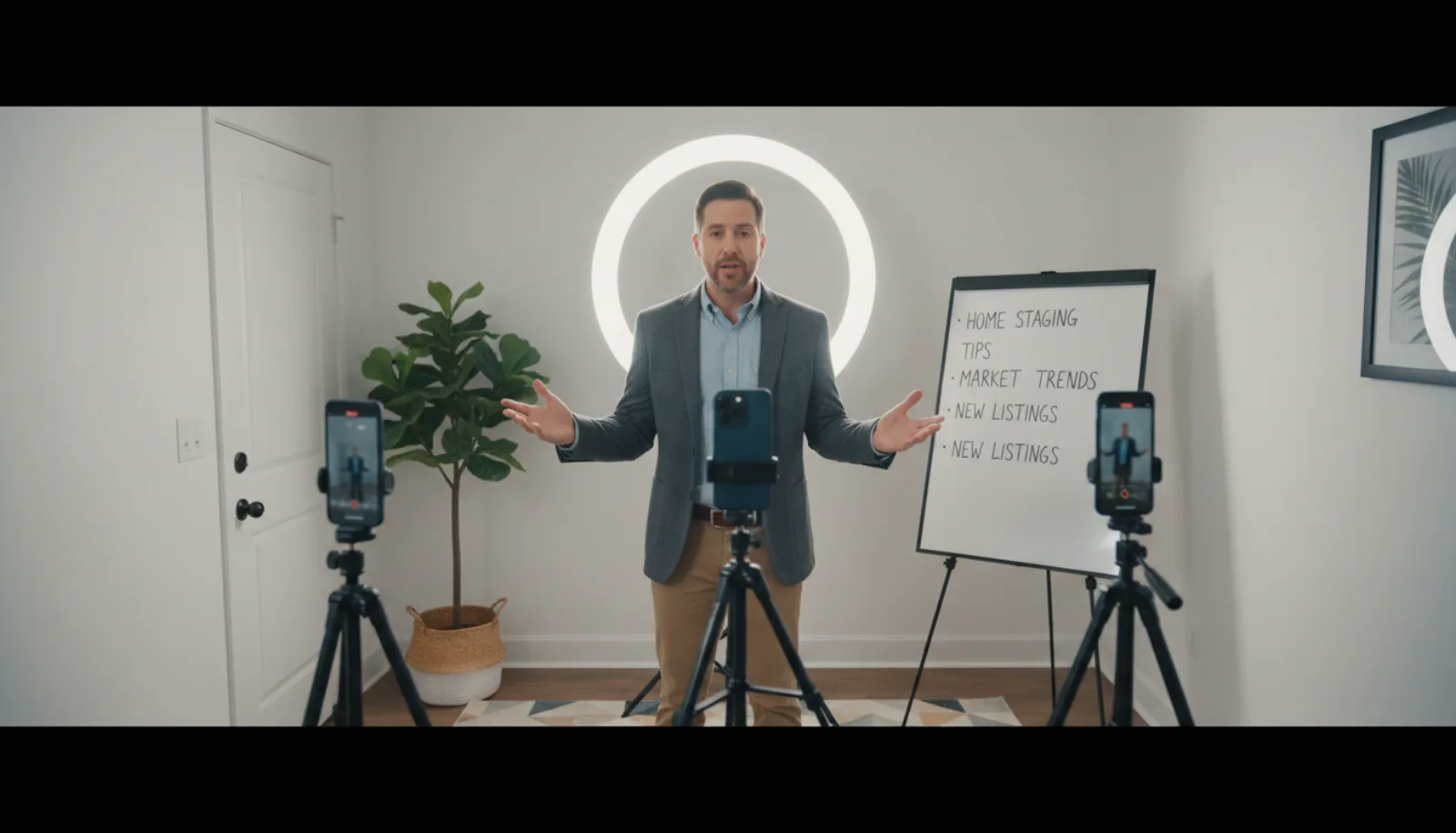
The “shoot in batches” half of the workflow looks like this in practice — three phones on tripods, a ring light, a script board, and an hour of recorded reps that feeds two weeks of feed:
For the paid-distribution side — once organic is humming and you want to amplify the best-performing organic content with Meta ads — Eric Preston’s complete Facebook Ads walkthrough is the most thorough free version, including the Special Ad Category for housing:
Daily (~10 minutes):
- Reply to DMs and comments
- Post one Story (behind-the-scenes from showings, market data, agent personality)
Weekly (~30 minutes):
- Schedule the week’s market-update or educational content
- Engage in 2-3 local Facebook groups
- Review last week’s analytics and adjust
That’s roughly 3-5 hours per week of social work for an agent doing 3-5 listings per month. Without automation, the same output requires 12-15 hours weekly — which is why most agents drop off after 2-3 months.
Common mistakes that kill real estate social accounts
The pattern of agents whose accounts plateau after 6 months looks identical:
- Posting only listings. Pure listing accounts feel like ads. The 60/30/10 mix (listings / educational / personal) keeps follower interest.
- Inconsistent visual identity. Random fonts, no logo, mixing 6 different color schemes across posts. Looks amateur.
- No CTA or wrong CTA. “DM for more info” gets ignored. “DM me ‘TOUR’ for a private 30-minute showing” gets messages.
- Treating each platform identically. Posting a 16:9 horizontal video to TikTok is dead on arrival. Each platform needs the right aspect ratio.
- Vanity metrics. Following counts and likes don’t pay closings. Track DMs, profile clicks, and saved posts — those correlate to leads.
- Quitting at 90 days. Most accounts plateau at 60-90 days because the algorithm hasn’t trained on the agent’s content yet. The agents who stick to 6+ months consistently break out. The ones who quit at 3 months conclude “social media doesn’t work for real estate” — when the real issue was insufficient time horizon.
How to measure if it’s working
The honest leading indicators (track weekly):
- Profile views — proxy for discovery
- DMs received — proxy for high-intent interest
- Saved posts — buyers save listings they’re considering touring
- Story replies — strongest signal of buyer interest
- Click-through to listing site / contact form — bottom-of-funnel
The lagging indicator (track quarterly):
- Listings or buyer leads attributed to social — ask new clients “how did you find me” and track the answer
Don’t optimize for likes or follower count in the first 90 days. Both are vanity metrics that lag actual lead generation by months and don’t predict closings.
FAQ
How much should real estate agents spend on social media marketing?
For most active agents, $0-50/month covers the tooling needed (one social automation tool, occasionally boosted posts). Hiring out the work to a marketing agency runs $500-3,000/month and only pays back at high listing volume — for solo agents and small teams, the math heavily favors the AI-tool approach.
Is social media marketing worth it for real estate?
Yes, for any agent doing 5+ transactions per year. The economics: a single listing lead from social typically converts at 5-15% to closing, and a closing is worth ~$8K-15K in commission. One social-sourced closing per quarter pays back any reasonable tool spend many times over.
What’s the best social media platform for real estate?
Instagram drives the most real estate leads in 2026 across most US markets, followed by TikTok for younger buyer markets and Facebook for older demos and local-group lead gen. The right answer for most agents is “all three, because they reach different buyers” — which is exactly the workflow problem AI multi-platform tools solve.
How long until social media marketing produces leads?
Realistic timeline: 30-60 days to first DM-based inquiry, 90-120 days to first closed transaction sourced from social, 6-12 months to consistent monthly social-attributable closings. Most agents who quit by 90 days do so right before the curve breaks.
Can AI write good real estate captions?
Yes. AI caption generators that pull from your listing data (price, location, features) produce captions and hashtags that match or beat hand-written ones in our usage data, and save 30-60 minutes per listing. The “AI sounds robotic” objection mostly applied to 2022-era tools — current models tone-match to the agent’s brand voice once configured.
Take it further
- BrightShot Social Media Automation — the AI tool that bundles the captions + overlays + multi-platform publishing in one workflow
- 29 real estate social media post ideas — companion post with templates and examples
- BrightShot vs Pedra — comparison of the two real-estate-specific social automation tools
- BrightShot AI virtual staging — the photo enhancement layer that feeds into your social pipeline
- BrightShot AI property videos — for the video side of the social workflow (Reels, TikTok)