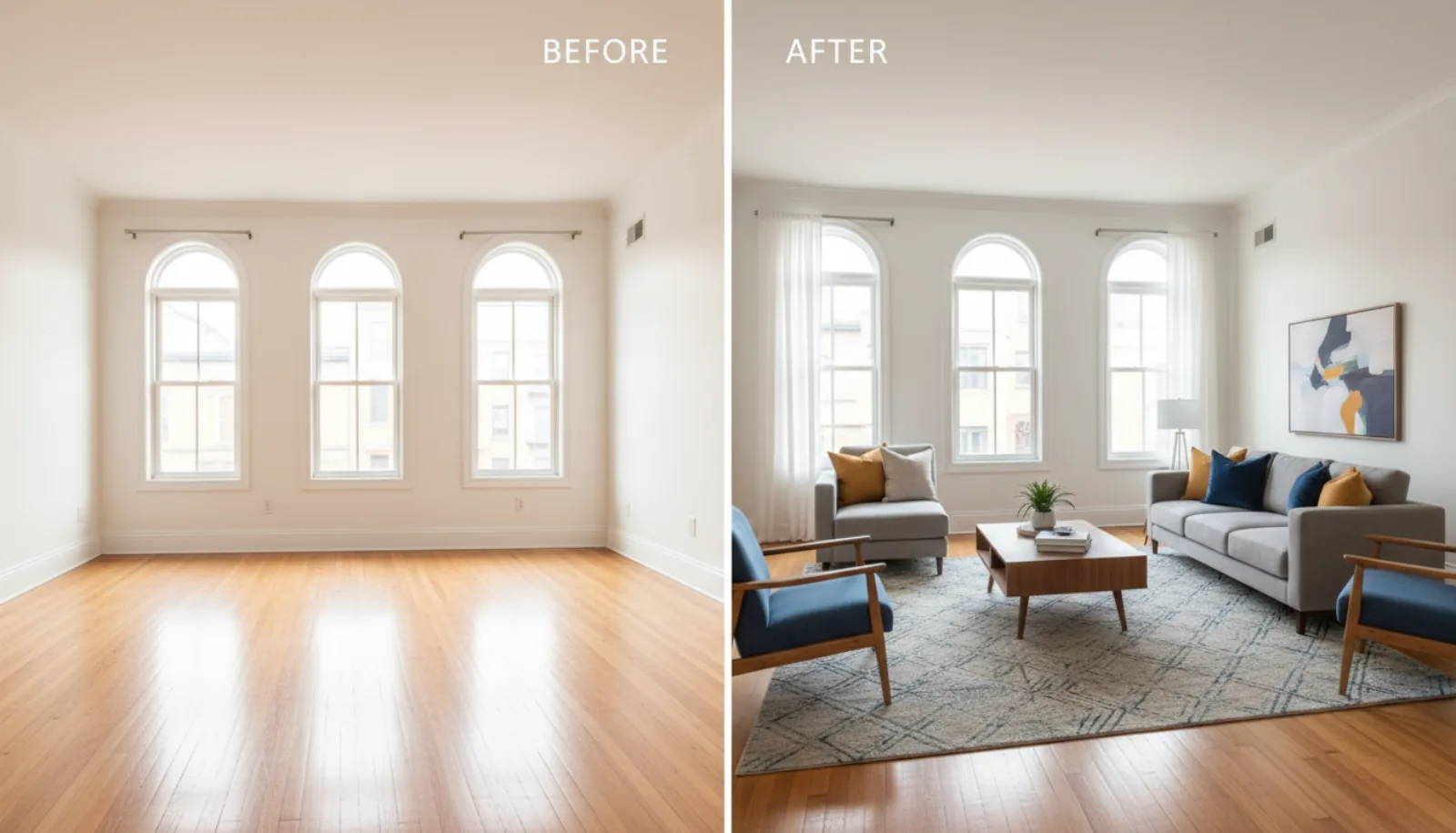
Homes with staged photos tend to perform better in the market. The National Association of Realtors reports that 81% of buyers’ agents said staging a home made it easier for a buyer to visualize the property as a future home. For listing photos, that matters because visualization drives clicks, showings, and the quality of early interest.
Good staging now has two jobs. It has to make the space work in person, and it has to make the camera read the room correctly. Those are not always the same thing. A layout that feels fine during a walkthrough can look tight in a wide-angle photo, and a room with natural charm can still photograph flat if the light, angle, or furniture scale is off.
That gap is where a lot of listing performance gets lost. The Real Estate Staging Association has noted that professional staging and strong photography work together because buyers usually see the home online first, and photos shape whether they book a showing at all. In practice, that means physical staging alone is only part of the job.
The stronger approach is hybrid and cost-aware. Use real furniture where scale, flow, and credibility matter. Use digital tools where speed, budget, or logistics make physical changes inefficient. That includes virtual furniture, lighting correction, sky replacement, object removal, style swaps, and AI-assisted media production that helps a home present at its best without overspending on every room.
This article focuses on that modern visual marketing stack. The goal is not to make every listing look overproduced. The goal is to make buyers understand the space faster, respond to it emotionally, and see a version of the home that supports the price. That same discipline shows up in retail and catalog imagery too, which is why many of the framing and composition principles overlap with this product staging guide.
1. Minimalist staging with strategic furniture placement
Minimalist staging works when it creates shape and flow, not when it strips a room bare. Buyers still need to understand scale, seating, and how people would move through the space. The trick is to stage only the pieces that explain the room.

In living rooms, that usually means one anchor sofa, one or two chairs, a restrained coffee table, and art scaled correctly for the wall. I’ve seen too many listings fail because the room was “decluttered” into looking unfinished. Minimalist staging should make the room feel larger, not emptier.
What actually works in photos
Furniture needs to define a conversation area without blocking the longest sightline. If you can show more floor and maintain clear paths to windows or doors, the room usually photographs better. This is especially useful in condos, new construction, and modern homes where clean architecture should stay visible.
The visual style matters less than the discipline. Southern Staging’s examples of living room setups emphasize furniture flow, texture contrast, statement art, greenery, and minimal window treatments, all of which translate well in listing photos and support stronger product staging decisions for visual merchandising and presentation.
Practical rule: If a side chair, ottoman, or accent table doesn’t improve the camera view from at least one main angle, remove it.
A good minimalist setup usually includes:
- One focal point: Center the room around a fireplace, view, built-in, or statement wall.
- Visible flooring: Let buyers see enough floor to understand room width and circulation.
- Quiet accessories: Use a few objects with texture, not lots of small decor that turns into visual noise.
What doesn’t work is “tiny furniture in a big room.” Staging professionals frequently note scale problems, especially with undersized art and decor in larger spaces, a recurring issue discussed in this analysis of staging proportion problems. Bigger pieces, used selectively, usually read better than too many small ones.
2. Virtual furniture staging and room visualization
The National Association of Realtors has repeatedly found that staging helps buyers picture a property as their future home. Virtual staging applies that same sales principle at a lower cost and with far more speed, especially for vacant listings, flips, and inherited properties that need market-ready photos fast.

Used well, virtual furniture staging answers three buyer questions in a single image. What fits here? How is the room supposed to function? What style does this home support? That matters because empty rooms often read smaller in photos, and awkward existing furniture can distract from layout, ceiling height, or natural light.
I use virtual staging when the architecture is marketable but the presentation is holding the listing back. That usually means a clean vacant room, a dated setup that photographs poorly, or a space with an unclear purpose, such as a loft nook, bonus room, or oversized bedroom. In those cases, digital furnishings are less about decoration and more about removing buyer friction.
BrightShot’s real estate virtual staging software is useful for testing layout options, style directions, and room purpose before paying for physical staging. Teams also use generative AI image and video tools to produce multiple visual concepts quickly, which is helpful when a property could attract both investor buyers and owner-occupants.
The best results come from restraint.
- Stage the main decision rooms first: Living room, primary bedroom, dining area, and home office usually influence clicks and showing requests more than secondary spaces.
- Match the likely buyer: A downtown condo can support sharper lines and lighter palettes. A family suburban home usually performs better with warmer, transitional furniture.
- Keep scale honest: Rugs, beds, and sofas need to fit the room dimensions, or buyers will sense the manipulation immediately.
- Show function, not software tricks: One strong layout beats several flashy versions that confuse the room’s purpose.
There is a trade-off. Virtual staging is cheaper and faster than physical staging, but it only works if the base photo is strong and the edits are believable. Bad shadows, floating furniture, inconsistent window light, or luxury decor dropped into a mid-range home will weaken trust. If the raw image has exposure problems, fix that first with lighting corrections that preserve window detail and interior balance.
Room visualization also works before the photoshoot. Sellers who are deciding whether to repaint, replace a bulky sectional, or convert a formal dining room into an office can compare versions before spending money. That is where the ROI gets stronger. Instead of guessing which changes will help the listing, agents can test presentation choices against the camera view that buyers will see.
A staged image should make the room easier to understand. If the edit draws attention to itself, it is the wrong edit.
3. Lighting enhancement and day-to-dusk conversion
Well-lit listing photos drive more clicks than dim, flat images, and that makes lighting one of the highest-ROI staging moves in the entire marketing stack. In practice, a strong lighting edit often does more for buyer perception than swapping decor.

This is one area where AI-assisted editing earns its keep. A capable editor can recover window detail, lift muddy shadows, correct mixed color temperatures, and keep white walls looking white instead of gray or yellow. That matters because buyers judge finish quality through photos first. If the light is off, paint, flooring, cabinetry, and even room size read worse than they do in person.
Day-to-dusk conversion works best as a selective upgrade, not a blanket style. Use it on the hero exterior when the home has outdoor ground lighting, a strong porch glow, a pool, or sunset-facing windows. That single image can add emotion to the gallery and help the listing stand out in search results. Use it on every exterior, and the presentation starts to feel synthetic.
The same discipline applies indoors. Living rooms, kitchens, and primary bedrooms usually deserve the most attention because they carry the strongest visual and emotional load in the listing. The National Association of Realtors has repeatedly highlighted those spaces among the rooms buyers respond to most in staging surveys, which is one reason careful exposure work in those rooms tends to pay back faster than spending time on a laundry room or secondary hallway.
A good lighting pass should look invisible.
That means preserving contrast, keeping lamp glow believable, and avoiding the two edits that hurt trust fastest. Pushed warmth that turns trim orange, and over-brightened shadows that erase depth. I also avoid heavy HDR treatments on mid-range homes. They can make surfaces look crunchy and exaggerated, which signals photo manipulation instead of good presentation.
There is a useful trade-off here. Lighting correction is usually cheaper than a reshoot and far cheaper than physical staging changes made only for the camera. But it cannot fix poor prep forever. If countertops are crowded or furniture blocks the window line, clean those issues up first or pair the edit with a decluttering plan for occupied homes before listing photos.
The best result is a gallery that feels bright, balanced, and credible. Buyers should register warmth, clarity, and mood within a second, without stopping to wonder what was edited.
4. Decluttering and object removal for clean aesthetics
Buyers make snap judgments from photos, and clutter gives them too much to process before they register the room itself. In listing galleries, that usually shows up as lower perceived space, weaker finishes, and less clarity around layout. Digital object removal solves a very specific problem. It strips out visual noise that the camera exaggerates, especially in occupied homes where perfect day-of-show prep is unrealistic.
I use physical prep first whenever possible because it improves both photos and showings. Digital cleanup earns its keep when the seller is still living in the home, the shoot window is tight, or a reshoot would cost more than the edit. That trade-off matters. Removing a few distractions in post is cost-effective. Rebuilding an entire room digitally usually looks fake and undermines trust.
Start with objects that steal attention from fixed features. The goal is to get buyers looking at the cabinetry, sightlines, flooring, storage, and natural focal points within the first second.
A practical prep checklist for occupied homes helps. This decluttering guide for homes going on the market works well when sellers need a room-by-room plan before photos.
Prioritize removal in this order:
- Personal identifiers: Family photos, diplomas, monograms, calendars, and highly specific collectibles.
- Daily-use clutter: Soap bottles, toothbrushes, cords, paper stacks, countertop appliances, remotes, and cleaning supplies.
- Pet-related items: Bowls, crates, litter boxes, scratched posts, and worn spots that dominate the frame.
- One-off distractions: Floor fans, extra trash cans, oversized hampers, and anything bright or reflective near the camera.
Restraint separates polished marketing from over-editing. A kitchen can keep one styled bowl or a coffee setup if it supports scale and feels intentional. A home office should still read as a workspace. I leave in enough context for the buyer to understand how the room lives, while removing the objects that make it feel cramped, chaotic, or overly personal.
That balance is especially useful because many listings never get full physical staging. Clean photo edits help agents present a tighter gallery without paying for furniture rental, storage, or multiple return visits. The best result looks edited in service of clarity, not edited for effect.
5. Sky replacement and outdoor enhancement
47% of buyers first notice the front of the home in listing photos, according to the National Association of Realtors. That makes the exterior thumbnail one of the highest-ROI images in the entire gallery.
Weather and timing distort exteriors fast. A strong listing can look tired under a blank white sky, dull winter grass, or muddy shadows across the front elevation. AI-assisted sky replacement and outdoor enhancement correct those conditions without paying for a second shoot, waiting for perfect weather, or sending the photographer back at sunset.
The best results stay tied to the property’s actual condition. A clean blue sky fits many homes. A warmer twilight treatment can work for luxury listings, homes with outdoor lighting, or properties where the exterior lighting package is part of the sale. The trade-off is credibility. If the sky is dramatic but the lawn is dormant, the driveway is wet, and the shadows point the wrong direction, buyers notice.
Good exterior enhancement usually includes four adjustments: sky replacement, lawn and foliage correction, cleanup of minor distractions, and contrast balancing on the façade. Those edits help buyers read rooflines, windows, porch depth, and entry points faster from a small screen. That matters because the exterior image has to compete in portal search results before a buyer ever opens the full gallery.
I treat curb-appeal editing as visual merchandising, not cosmetic fiction. Keep the season coherent. Keep the light coherent. Keep the materials honest.
A practical standard works well here. Use skies that match the region and time of year. Improve grass color, but do not turn a stressed lawn into a golf course. Remove a stray bin or hose if it hijacks the frame. Leave permanent site realities in place. If power lines, a steep driveway, or a neighboring structure affect the property, the photos still need to represent that truth.
Buyers will tolerate cloudy weather at a showing. They will skip a listing that looks flat in search.
This technique earns its keep because it improves the image buyers see first, and it does it at a fraction of the cost of exterior landscaping work before launch. For agents and sellers using modern staging workflows, that is the point. Better visual performance, faster turnaround, and a sharper first impression without crossing into misrepresentation.
6. Interior style transformation and design alternatives
A dated room can lose buyer interest in a second, even when the floor plan is strong and the finishes are perfectly serviceable. Style affects click-through, perceived value, and how current the property feels in photos. That makes digital style transformation a practical marketing tool, not just a design exercise.
Used well, it lets agents and sellers test different visual directions before spending money on furniture rental, paint, or accessories. That matters on listings where the architecture can support more than one look, or where the likely buyer profile is still unclear. I use this approach to answer a simple question fast: which style makes this home feel more expensive, more livable, and easier to understand online?
The best results come from matching the visual treatment to what cannot change in the room. Flooring, cabinet lines, window shape, ceiling height, and trim detail should set the direction.
A few common pairings work well:
- Minimalist or contemporary: Fits newer condos, infill homes, and properties with sharp lines or limited square footage.
- Transitional: Often the safest option for suburban resale because it softens dated elements without fighting them.
- Rustic, farmhouse, or warm organic styles: Work best when the home already has natural wood, heavier millwork, or a more informal setting.
Consistency matters more than novelty. A listing gallery should not present the living room as industrial, the bedroom as coastal, and the kitchen as traditional. Buyers may not know the design labels, but they notice when the story changes from room to room.
There is also a clear cost trade-off here. Physical restaging a room in two or three different aesthetics is expensive and slow. Digital transformation gives the listing team options early, which helps with positioning before the final media set goes live. For teams pairing stills with interactive media, this approach also works well alongside 360° virtual tour planning and presentation, because the design direction can stay consistent across the full buyer experience.
The guardrails are simple. Keep fixed finishes honest. Do not add luxury materials that are not present in the property. Do not change the architecture to chase a trend. The goal is to show the home’s potential in a style the market will respond to, while keeping the presentation credible.
7. 360° virtual tours and immersive property exploration
Listings with interactive media often hold attention longer because buyers can answer a different question than photos answer. Photos sell the highlights. A 360° tour shows whether the home works.
That matters most when layout is part of the value story. Split levels, loft conversions, narrow townhomes, ADU setups, and homes with strong indoor outdoor connections usually photograph well, but buyers still want to understand circulation, sightlines, and room relationships before they commit to a showing.
For agents building that workflow, BrightShot’s guide on how to create virtual tours for real estate covers capture choices, room sequencing, and presentation details that affect buyer response.
Here’s the embedded format many teams use for marketing content and distribution:
Where immersive tours help most
Use 360° tours when a standard gallery leaves too much open to interpretation.
They are especially effective for:
- Homes with unusual flow: Buyers can verify how spaces connect without guessing from wide-angle stills.
- Remote and relocation buyers: The tour helps screen serious prospects before travel or live video showings.
- Listings with strong engagement but weak showing conversion: That pattern usually signals uncertainty about layout, scale, or usability.
- Properties with secondary spaces: Basements, bonus rooms, detached offices, and ADUs are easier to understand in an interactive format.
There is a trade-off. A 360° tour increases transparency, which is exactly why it works and exactly why sloppy prep hurts. Dust on baseboards, crowded countertops, warped bedding, and awkward storage zones all become more obvious once buyers can pan the room themselves. Static photos let a listing team control the frame. Immersive media removes that protection.
Use that to your advantage. Stage for movement, not just for hero shots. Clear walking paths, open key doors, align furniture to show true scale, and make sure each transition answers a buyer question about where they go next. The best tours feel easy to follow because the staging and capture plan were built together.
I also recommend being selective. Not every listing needs a full-property interactive tour. If the floor plan is straightforward and the photo set already explains the home clearly, a tour may add cost without adding much conversion value. On the right property, though, it can reduce low-intent showings and improve lead quality because buyers arrive with a more accurate read on the space.
8. Cinematic video walkthroughs with AI enhancement and branding
Listings with video tend to win more attention because motion explains what still photos cannot: flow, sequence, and scale. For agents and sellers, that makes video less of a nice extra and more of a distribution asset that can carry the same staged home across social, email, YouTube, and paid campaigns.
The highest-performing walkthroughs are built for buyer behavior, not for vanity. Buyers decide fast. The opening few seconds need to answer a simple question. Is this home worth my time?
AI helps on both the production side and the editing side. It can stabilize shaky clips, smooth exposure changes between rooms, clean up color, remove minor distractions, generate captions, and resize the same walkthrough for vertical, square, and horizontal placements. That lowers production cost, especially when a listing already has strong stills and only needs short-form video cutdowns for marketing.
Sequence the story like a showing
A good walkthrough follows the logic of arrival and discovery. Start with the exterior or strongest first impression. Move through the main living spaces in a way that makes orientation easy. Hold back one or two payoff moments, such as a remodeled kitchen, a skyline view, or a strong primary bath, for the middle of the video where retention usually starts to dip.
Useful production choices include:
- Short branded intro and outro: Keep branding present but restrained.
- On-screen text: Call out upgrades, dimensions, or lifestyle features for viewers watching on mute.
- AI color and exposure matching: Keep the home consistent from room to room.
- Multiple cuts from one shoot: One version for listing pages, one for social ads, and one for text follow-up.
There is a real trade-off here. Heavy editing can make a property feel slick, but it can also damage trust if the home looks different in person. I tell teams to use AI for correction and clarity, not fantasy. Stabilize the footage. Improve brightness. Clean audio. Add branding. Do not create a movie trailer that oversells an average house.
That restraint matters because video extends the value of staging rather than replacing it. Strong furniture placement, lighting, and styling give the camera something to follow. Weak prep gets exposed fast once the viewer sees awkward transitions, empty corners, or rooms that look disconnected.
The best walkthrough leaves the buyer with a clear mental map of the home and a clear memory of the brand behind it. That is what gets more clicks, better inquiries, and stronger showing intent.
9. Perspective view transformation and angle optimization
Some listing photos fail because the room is bad. Others fail because the angle is. Perspective correction can salvage rooms that were shot too wide, too low, or with distracting distortion that bends walls and shrinks depth.
This is one of the most underrated parts of strong home staging ideas pictures. Buyers often can’t explain why a room feels “off” in a photo, but they notice when verticals lean, furniture feels lopsided, or ceiling height looks compressed.
Fix the frame before you add decor
Correcting perspective should happen before major enhancement decisions. Once the room geometry is cleaner, it becomes easier to judge whether the furniture arrangement works, whether the art is the right size, and whether the image needs additional virtual staging.
Useful adjustments include:
- Straightening verticals: Especially important in kitchens, bathrooms, and exteriors.
- Reducing wide-angle stretch: Helps furniture keep realistic proportions.
- Selecting stronger viewpoints: Sometimes a different crop tells the room better than a heavier edit.
This issue ties back to a common staging blind spot. Stagers often focus on the cohesive feel of a room in person, but not every arrangement survives multi-angle photography well, as discussed in the earlier staging-and-camera analysis. A room that feels balanced from one standing position may break apart visually in the lens.
Slightly oversized decor often reads better on camera than decor that disappears into the wall.
What doesn’t work is using perspective tools to create deceptive room size. Correcting distortion is fair. Manufacturing a layout that the buyer won’t experience in person is not. Good angle optimization improves clarity, not honesty.
10. Seasonal and temporal property showcasing
Listings with the right seasonal imagery often win attention faster because buyers are not only judging the house. They are judging how the property will live during the moments they care about most.
This technique works especially well for homes with a strong lifestyle component. Pools, outdoor kitchens, fireplaces, ski access, lake frontage, roof decks, and big-view patios rarely photograph at their best in every month or every hour. A smart marketing package uses AI-assisted photo planning and enhancement to show the property in its strongest seasonal context without scheduling four separate shoots.
The goal is not to document every possible condition. The goal is to match the visuals to the buyer’s likely use case. A family-focused suburban listing may need a bright late-spring backyard image that shows room to gather. A second home in the mountains may perform better with a winter exterior and a warm interior fireplace shot. An urban condo often benefits from a twilight balcony image with the skyline active in the background.
Choose the season that supports the purchase decision
Seasonal and time-based visuals should answer practical buyer questions. Will this patio feel usable after work hours? Does the backyard support summer entertaining? Does the firepit area read as a real amenity or dead square footage? Those are marketing questions, not decorative ones.
As noted earlier, agents consistently prioritize staging the rooms that carry the strongest emotional weight, especially living rooms and primary bedrooms. Seasonal storytelling should strengthen those spaces rather than distract from them. Morning light in a breakfast area, a fireplace scene that gives the living room purpose, or a primary suite image with soft winter-day ambience can help the photos sell a lifestyle buyers already want.
A few applications I use regularly:
- Outdoor living properties: Combine one clear daytime hero image with one evening image that shows lighting, seating, and atmosphere.
- Relocation listings: Use alternate seasonal visuals to show the home’s appeal beyond the weather on shoot day.
- Vacation and second-home listings: Show the season buyers are shopping for, or the season that drives the highest perceived value.
- Homes with gardens or mature landscaping: Use peak-season exterior images if current conditions undersell the lot.
There is a trade-off here. Seasonal enhancement can improve click-through rate and emotional response, but it has to stay honest. Adding autumn color to trees is one thing. Inventing a lush summer lawn during a drought, or showing snow on a property that rarely gets it, creates a credibility problem the first time a buyer visits.
Holiday decor creates the same issue. A few neutral cues can make a room feel warm. Full holiday styling dates the listing, narrows buyer appeal, and can make photos feel stale within weeks. Timeless atmosphere usually produces a better return than seasonal gimmicks.
10-Point Comparison of Home Staging Photo Techniques
| Technique | 🔄 Implementation Complexity | ⚡ Resource Requirements & Speed | ⭐ Effectiveness / Quality | 📊 Expected Outcomes / Impact | 💡 Ideal Use Cases / Key Tip |
|---|---|---|---|---|---|
| Minimalist Staging with Strategic Furniture Placement | Low–Medium, simple declutter + layout decisions | Low resources; fast to implement (physical or virtual) | High ⭐, emphasizes space and flow | Improved perceived space, lower staging cost, increased showings | Best for modern/urban and luxury condos; use AI declutter & bright lighting |
| Virtual Furniture Staging and Room Visualization | Medium, requires AI tools and style selection | Low ongoing cost; very fast per image | Very High ⭐⭐⭐, photorealistic and scalable | Increased inquiries, cost savings vs. rentals, rapid A/B testing | Ideal for vacant/new construction and high-volume listings; start with high-quality photos |
| Lighting Enhancement and Day-to-Dusk Conversion | Medium, needs careful exposure and color calibration | Low–Medium effort; quick processing | High ⭐, strong emotional impact when natural-looking | Dramatically improved photo quality and curb appeal; better evening imagery | Use for dark interiors/exteriors; maintain realism and verify MLS rules |
| Decluttering and Object Removal for Clean Aesthetics | Low, straightforward edits but varies with scene complexity | Low resources; batch processing efficient | High ⭐, creates neutral canvas for buyers | Faster listing readiness, improved initial appeal for occupied homes | Focus on personal items first; preserve functional furniture to avoid emptiness |
| Sky Replacement and Outdoor Enhancement | Low–Medium, automated but needs color/horizon matching | Low cost; quick edits; mindful of board rules | Medium–High ⭐, boosts exterior appeal when natural | Strong increase in curb appeal and marketing click-throughs | Best for cloudy climates and exterior-focused listings; match color temperature |
| Interior Style Transformation and Design Alternatives | Medium, selection and style matching required | Moderate resources for high-quality variants; fast per style | Very High ⭐⭐⭐, appeals to varied buyer tastes | Broader buyer engagement, social content variety, faster decision-making | Select 3–5 target styles; ideal for blank/basic properties and social campaigns |
| 360° Virtual Tours and Immersive Property Exploration | High, requires capture hardware, hosting and stitching skills | High initial investment; slower production but long-term value | Very High ⭐⭐⭐, highly engaging and credible | Increased time-on-site, reduced unnecessary showings, remote buyer conversions | Best for luxury, commercial, and out‑of‑market buyers; combine with enhanced images |
| Cinematic Video Walkthroughs with AI Enhancement and Branding | Medium–High, sequencing, pacing and licensing considerations | Moderate resources; rapid turnaround using stills | High ⭐, excellent for social engagement and branding | Significant uplift in video engagement and listing visibility | Ideal for social-first marketing and younger demographics; use branded templates |
| Perspective View Transformation and Angle Optimization | Medium, geometric corrections and careful retouching | Low–Medium resources; works with existing photos | High ⭐, fixes composition and improves spatial perception | Better perceived space dimensions, more professional listings | Use when original photos are suboptimal or for small/odd-shaped rooms |
| Seasonal and Temporal Property Showcasing | Medium–High, multiple scenarios increase complexity | Moderate resources and planning; multiple deliverables | Medium–High ⭐, effective for season-sensitive appeal | Year‑round marketing content, supports relocation decisions and seasonal buyers | Best for vacation/seasonal properties; limit to 3–4 key seasonal variations |
From pictures to profit Your next move
Staged homes consistently outperform unstaged listings in industry reporting, and that result tracks with what agents see in the field. Better photos generate more clicks, more saves, and better qualified showings. In a market where buyers screen homes on a phone before they ever book a tour, visual presentation affects demand earlier than price negotiations do.
That is the practical case for home staging ideas pictures. Strong images help buyers read the layout fast, understand scale, and connect emotionally with the property before they step inside. The highest return usually comes from a hybrid approach that combines selective physical staging with digital production tools. AI-assisted furniture placement, object removal, lighting correction, style testing, sky cleanup, and immersive media let a team fix the exact weakness that is hurting response without paying for a full traditional stage on every room.
The budget question matters, and the answer is usually more flexible than sellers expect. The National Association of Realtors has long reported that many agents use staging strategically rather than across the entire property, especially when budget is tight. That matches current practice. Spend where the camera gets the payoff first, then use virtual tools to finish the story in the listing gallery.
Start with the bottleneck. A vacant condo often needs virtual furniture to establish scale. A dark ranch needs lighting work before it needs anything decorative. A lived-in family home may get the biggest lift from object removal and cleaner styling. If the exterior has strong bones but the weather was flat on shoot day, outdoor enhancement can do more for click-through rate than another round of interior edits.
This is not about making a home look artificial. It is about reducing friction in the buyer’s first scan of the listing. Clean composition, accurate brightness, believable staging, and modern delivery formats such as tours and short-form video help a property compete against better marketed homes in the same price band.
I treat listing media as a sales asset with a production budget, not as an afterthought. That mindset changes decisions fast. Instead of asking whether every upgrade is necessary, ask which visual fix is most likely to improve attention, showing quality, and final offer strength.
BrightShot helps agents, photographers, stagers, and property teams turn ordinary listing photos into listing-ready marketing fast. If you want to test virtual staging, decluttering, lighting correction, sky replacement, style changes, 360° tours, or video walkthroughs without a long production cycle, try BrightShot and see how quickly stronger visuals can improve your next listing.